Taiji, Supreme Ultimate
The Unity of Opposites:
In Eastern thinking, 2 forces are thought to cause all change: Yin and Yang. While the traditional Western idea of Yin and Yang are limited to
discussions of balance, Eastern ideals on Yin and Yang are used to describe the foundation of existence. Below is a depiction of Taiji, the
interaction between Yin and Yang
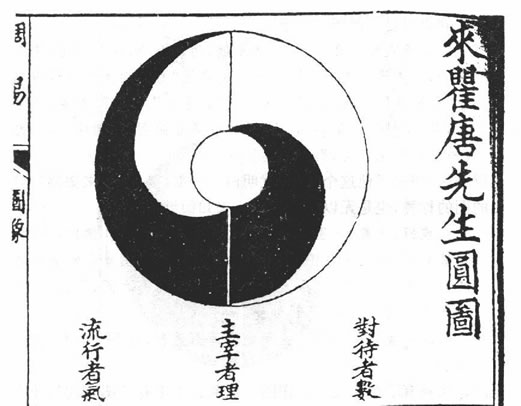
Taiji, translated roughly into "Supreme Ultimate", describes the interaction between Yin and Yang. As quoted by Confucian Scholar Chu Hsi:
"The Supreme Ultimate through activity produces Yang. Activity, having reached its limit, there is quiet. Through quiet, the Supreme Ultimate produces Yin. When quiet reaches its limit, there is a return to activity; Thus activity and quiet each in turn becomes the source of the other"
The Supreme Ultimate resolves the conflict of the traditional understanding of Yin and Yang; one complements the other, there is no active conflict between them.
Properties of Yin: cold, tranquil, inhibitory, heavy
Properties of Yang: warmth, activity, brightness, excitation
To better understand these interactions between Yin and Yang, the Supreme Ultimate has led to 5 fundamental derivations by Chinese Scholars:
- All phenomena can be classified into Yin or Yang
- Yin and Yang are relative concepts
- Yin and Yang are independent
- The current state of balance between Yin and Yang is always dynamic
- Under certain circumstances, Yin may become Yang; the opposite applies.
I will now go over some of these derivations:
Yin and Yang are relative:
While the properties of Yin and Yang will always be absolute, the Ying and Yang properties of a system are variable and relative with the respective context.
Futhermore, each system has a Yin- and Yang- component. Thay are different for each object but hold the properties defined of Yin and Yang.
Yin and Yang are Dynamic:
In any object or phenomenon, the opposing aspects of Yin and Yang are always dynamic. The Supreme Ultimate describes how the cessation of activity will once again
lead to a rise in said activity. Such examples include day and night, the cycle of seasons, or the interaction between fire and water.
This fact is also how the derivation of the Yin state becoming the Yang state was theorized.